
Commercial SaaS product
Fatai
An Arabic-first SaaS product for businesses working through WhatsApp, bringing customer conversations, business context and automation into a shared workspace.
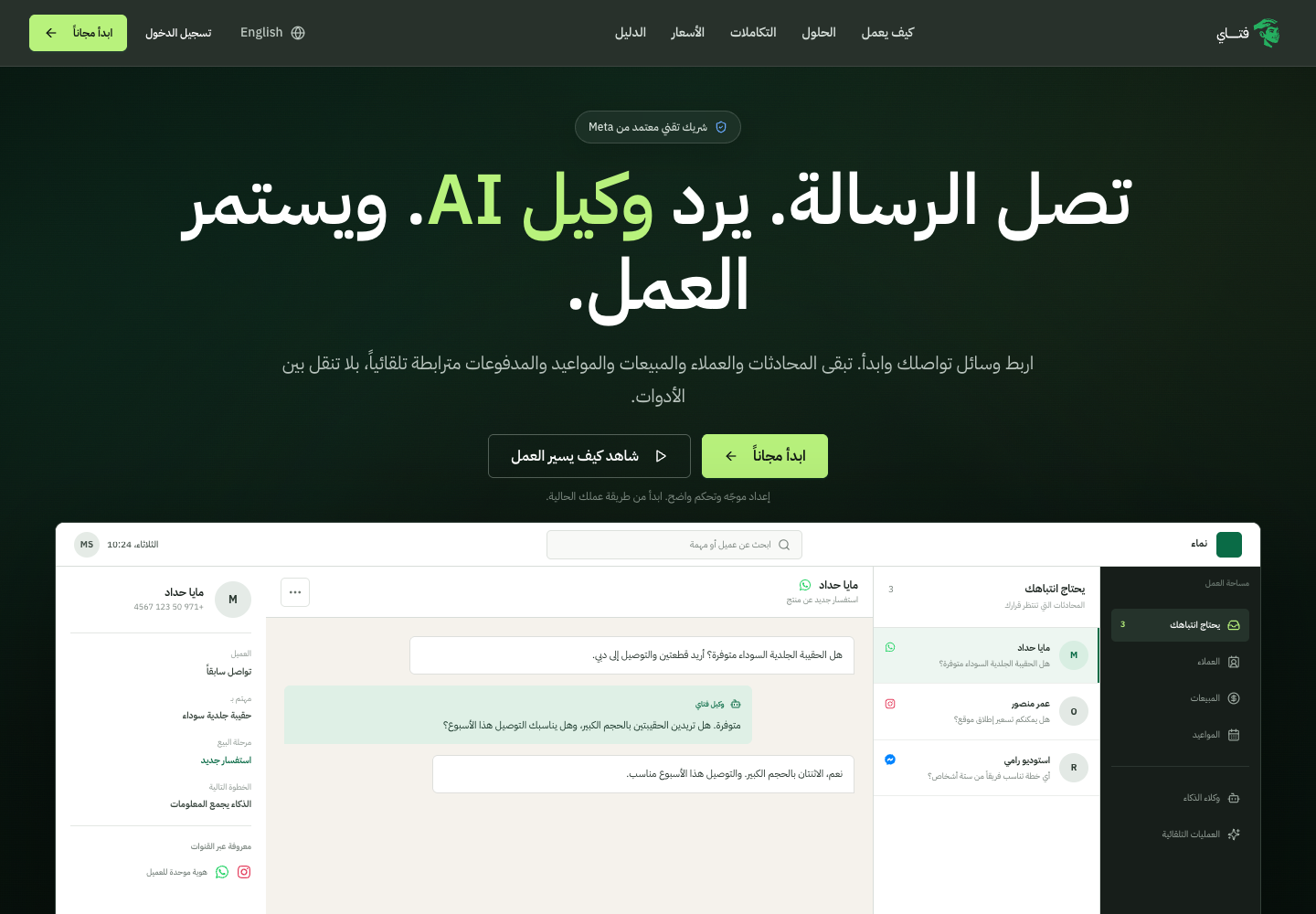
From a client problem to a product in use.
Where it started
Fatai grew out of a recurring problem in our client work: the WhatsApp tools available to us did not adequately support the way those businesses handled customers. Conversations carried sales enquiries, service requests and ongoing relationships, while the context and responsibility for the work were spread elsewhere. We began building our own solution, then developed it into a product we could offer to other businesses.
From solution to SaaS
Turning the solution into SaaS meant creating a reusable operating foundation. Customer identity, business records, action definitions and execution history needed to remain consistent across the product UI, AI agents, automations and external APIs. Around that foundation, we built the messaging experience, business modules, integrations, onboarding and subscription operations.
Our product work
- Product definition, architecture and ongoing development
- Shared customer context and canonical business contracts
- Canonical capability registry and execution foundations
- Arabic-first messaging, CRM and customer work
- External APIs, provider integrations and automation
- Organization setup, onboarding, subscriptions and usage management
The architecture work
Shared foundations.
Consistent business behavior.
The substantial engineering work sits beneath the inbox: a shared model for customer identity, business records, permissions and executable actions. The product interface, agents, automations and APIs use that foundation, while specialist modules retain responsibility for their own business rules.
The product architecture
One execution foundation across the product.
A supported business action needs the same meaning whether it starts with a person in the interface, an AI agent, an automation or an API request. Fatai centralizes capability definitions and operation tracing, with permissions and approvals enforced by the responsible execution paths.
Original architecture diagram, slide 15 of the August 2026 product-foundation presentation.
- A shared action definition
- Canonical capabilities identify the action, its execution status and its side effects. Planned or unsupported capabilities cannot become executable simply because an interface exposes them.
- APIs use the product foundation
- External API operations enter the same canonical operation gate. Their authentication and domain checks still apply; the API is another way into the product’s supported capabilities.
- A traceable result
- Operation records connect what was attempted with its outcome and origin. Business modules retain their own records, such as messages, campaign delivery and billing evidence.
The product architecture
A canonical layer for changing providers.
Different providers describe events, customers and actions differently. The architecture translates those differences into consistent product contracts before business execution. This contains provider-specific behavior at the integration boundary and keeps the owning business modules authoritative.
Original architecture diagram, slide 16 of the August 2026 product-foundation presentation. The contracts illustrate the operating model and are not a list of universally available integrations.
- Events: what happened?
- Provider signals are expressed as product events that the rest of the system can interpret consistently.
- Entities: which record is authoritative?
- Customers, appointments, orders and other records have defined ownership and meaning within the product.
- Capabilities: what action is allowed?
- Supported commands reach the relevant business operation through explicit permissions, required approvals and execution checks.
An ongoing product
The work continues
after release.
Fatai is already being sold and used by customers. We continue to develop and operate it as a SaaS product, with a wider market launch planned.
- In commercial use
- Customer use sits alongside the work of onboarding businesses, managing subscriptions and usage, maintaining integrations and releasing updates.
- Continuing development
- The work continues across the customer experience, reliability, integrations and product architecture. Newer Agent setup and readiness experiences remain part of the evolving roadmap.
- Next market stage
- A broader market launch is planned. It is presented here as the next stage, separate from the commercial use already under way.
Your next project