Construction procurement depends on knowledge distributed across suppliers, sales teams and site operations. Materials are described differently, commercial terms vary, and availability depends on specifications, quantities and location. Building Scale meant establishing a shared language and operating rules that could accommodate this variation and carry a requirement through to an executable order.
The approach
Start with the foundations: define material identity, separate product facts from changing commercial terms, and establish when a supplier can fulfil a requirement. Carry those rules through sales, quotations and operations so each team works from the same facts, while preserving the details of what was agreed.
The work
Material classification, specifications and valid variants
Supplier pricing, coverage and commercial availability
Quantity rules, delivery planning and order coordination
Product architecture, development and operational interfaces
The decisions behind the system
Making an order possible.
A request can sound simple. Making it precise, commercially valid and ready to fulfil takes a shared set of rules.
01 / A shared material language
First, agree on what is being ordered.
Names alone cannot define a material. Type, dimensions and other specifications distinguish products that may sound similar in everyday conversation.
Scale gives valid material combinations a consistent identity. Market vocabulary can help people find them without changing what the product actually is.
What this makes possible Sales and suppliers can refer to the same material, and operations can carry that specification through to delivery.
Illustrative material definition
“We need cement blocks.”
A useful starting point. More detail is needed.
Block type
Regular
Insulation
Uninsulated
Form
U-shaped
Size
20 cm
One defined materialRegular, uninsulated, U-shaped block · 20 cm
Based on a documented Catalog definition. The request wording is illustrative.
02 / Commercial reality
A listed material is only the beginning.
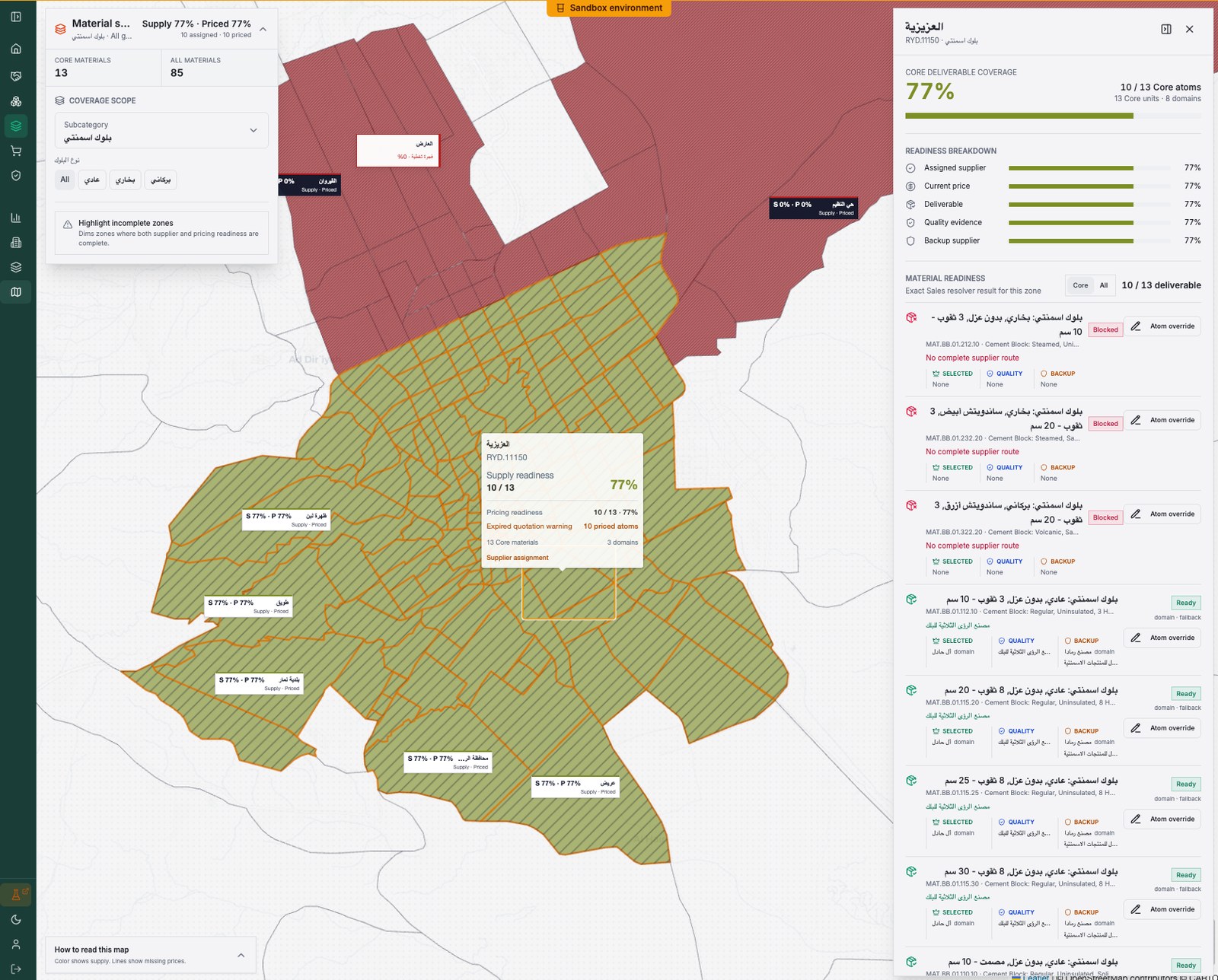
A material in the catalog needs a usable supplier price and delivery coverage for the project location before it can become an available sales option.
The quantity matters too. Some materials can share a delivery plan; others must meet their own full-load requirement.
What this makes possible A quotation is grounded in a supply and delivery plan, with missing information made visible before commitment.
Actual Scale interface, cropped to the readiness panel. Sandbox capture; figures are illustrative of the interface, not current business results.
03 / A reliable agreement
Keep the agreement intact as the work moves on.
Prices and catalog information can change while an order progresses. The terms already sent or accepted need to remain traceable.
Scale preserves quotation and order records at the relevant point in the process. Later changes follow an explicit revision or approval path.
What this makes possible The team can distinguish the original agreement from subsequent changes and coordinate fulfilment against the right version.
Illustrative record model
At commitment
The agreed record
Material · quantity · price · delivery context
Preserved with the quotation or order
As circumstances change
A visible change path
New information is reviewed through the relevant revision or approval process.
The original agreement stays traceable
A simplified explanation of the operating model.
The original project architecture
The wider operating model.
The foundation architecture map connects sales, quotations, supplier assignment, delivery, payments and follow-up. It provides the wider context for these decisions.